


Jilin University team achieves breakthrough progress in the field of novel diamond synthesis!
Release date:
2025-05-20
Four-coordinate (sp3 hybridized) is the thermodynamically stable configuration for carbon under high pressure. However, in an extremely broad pressure range, the face-centered cubic structure is the thermodynamically most stable form of diamond. Consequently, synthesizing novel diamond materials with non-cubic phases presents both theoretical and technical challenges. Recently, Ji...
Four-coordinate (sp3 hybridized) is the thermodynamically stable configuration for carbon under high pressure. However, within a very broad range of pressures, the face-centered cubic structure is the thermodynamically most stable. Diamond Structure. Therefore, synthesizing novel diamond materials with non-cubic phases presents both theoretical and technical challenges.
Recently, Jilin University School of Physics, Center for Extreme High-Pressure Science, and High-Pressure Studies Ultra-hard materials Professor Bingbing Liu and Professor Hu Tang’s team from the National Key Laboratory have developed a new approach Diamond Synthesis Groundbreaking progress has been made in the field. By integrating a key core technology—non-equilibrium uniaxial stress—into the large-volume press of the nation's major scientific infrastructure, the "Comprehensive Extreme Conditions Experimental Facility: High-Temperature, High-Pressure, and Large-Volume Materials Research System," researchers have successfully synthesized millimeter-scale, high-quality hexagonal diamond and metastable diamond. In collaboration with Professor Yanglong Hou and Professor Shengcai Zhu's teams from Sun Yat-sen University, advanced large-scale molecular dynamics simulations were employed to elucidate the underlying mechanisms at the atomic level. Graphite The dynamic process of hexagonal diamond and metastable diamond formation from fullerenes under non-equilibrium, high-pressure conditions.
The series of achievements were published under the titles "Direct Synthesis of Millimeter-Sized Hexagonal Diamond from Graphite," "Key to Hexagonal Diamond Formation: Theoretical and Experimental Study," and "Uniaxiality-Induced Reduced-Pressure Synthesis of Ultrahard Paracrystalline Diamond" in the internationally renowned journals *Science Bulletin*, *Journal of the American Chemical Society*, and *Advanced Materials*, respectively.
Synthesis of Millimeter-Scale Pure Hexagonal Diamond Phases and Investigation of Graphite's High-Pressure Phase Transition
Since its proposal in the 1960s, hexagonal diamond has garnered significant attention due to its theoretical hardness being 50% higher than that of cubic diamond. However, the unclear formation mechanism of hexagonal diamond and limitations in high-pressure experimental techniques have made it extremely challenging to synthesize pure-phase hexagonal diamond. The research team suggests that conventional large-volume high-pressure devices (6–8) are particularly prone to disrupting the delicate stacking order of graphite layers, thereby eliminating the intrinsic kinetic advantages that make synthesizing hexagonal diamond from graphite possible. This is precisely why obtaining pure-phase hexagonal diamond has remained elusive over the past half-century.
The research team has designed a new high-temperature, high-pressure apparatus (6-8-2) to address this challenging technical issue: By introducing uniaxial stress into the conventional high-pressure setup, they were able to preserve the intrinsic structure of graphite during compression, thereby facilitating the formation of hexagonal diamond (Chinese authorized invention patent: ZL 2024 1 0904498.8). Using this innovative device, the team successfully synthesized millimeter-scale, single-phase hexagonal diamond under conditions of 20 GPa and 1773 K (Figure 1). Furthermore, macroscopic XRD and microscopic PED analyses were employed to conclusively rule out the presence of graphite or cubic diamond in the sample. Complementing these experimental findings, molecular dynamics simulations (Figure 2) clearly revealed the transformation pathway of graphite into hexagonal diamond via an intermediate "orthorhombic graphite" phase, while also highlighting how thermal kinetics during nucleation and growth can lead to the formation of intrinsic stacking faults in the hexagonal diamond structure.
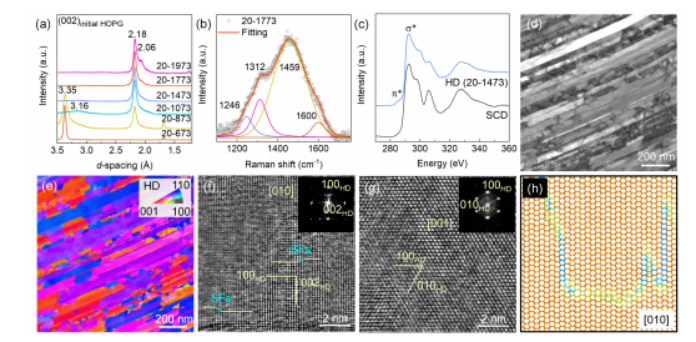
Figure 1. Structural characterization of the synthesized hexagonal diamond bulk: XRD (a); Raman (b); EELS (c); PED (d-e); HRTEM (f-g); and simulated atomic structure diagram (h).

Figure 2. The synthesis mechanism of hexagonal diamond: the structural transformation from AB-stacked graphite to hexagonal diamond under high temperature and pressure.
Meanwhile, the study further revealed that the kinetic pathway of graphite transforming into diamond is highly sensitive to pressure. Reducing the pressure promotes the conversion of graphite into thermodynamically stable cubic diamond (as shown in Figure 3). This finding confirms that under high-pressure, low-temperature conditions, the inhibition of interlayer sliding in graphite preferentially stabilizes the hexagonal diamond phase, whereas increasing temperature or decreasing pressure activates a competitive nucleation mechanism favoring cubic diamond formation. The results indicate that 15 GPa serves as a critical pressure point, at which graphite simultaneously undergoes transformations into both cubic and hexagonal diamond structures. Notably, the (002) plane of graphite reorients into the hexagonal (100) and cubic (111) planes, giving rise to a unique composite material featuring a distinctive cubic/hexagonal heterostructure—distinct from the traditionally understood coherent interfaces formed between cubic (111) and hexagonal (002) diamond phases.

Figure 3. Cubic/hexagonal diamond composite material synthesized under low pressure (15 GPa) with a heterostructure.
The study systematically characterizes the mechanical and functional properties of hexagonal diamond (Figure 4). It reveals that the synthesized hexagonal diamond exhibits significant anisotropy in its mechanical behavior: its Vickers hardness reaches 165 ± 4 GPa along the [100] direction perpendicular to the surface, while it drops to 124 ± 4 GPa parallel to the surface. Notably, the hardness in the perpendicular direction is 61.8% higher than that of cubic diamond on the (100) plane. Additionally, nanoindentation tests indicate that the Young’s modulus of hexagonal diamond is 1132 ± 5 GPa along the [100] plane, representing a 6.8% increase compared to cubic diamond’s (100) plane value of 1060 ± 15 GPa. Hexagonal diamond also possesses a band gap of 4.59 eV, which is 10.2% narrower than that of single-crystal cubic diamond (5.11 eV). Furthermore, thermogravimetric-differential scanning calorimetry (TG-DSC) analysis demonstrates that hexagonal diamond remains stable up to 900 K in air.
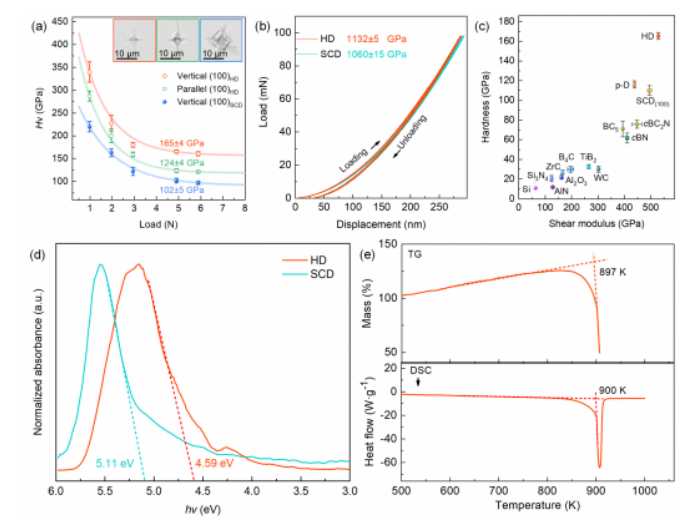
Figure 4. Physical and chemical properties of hexagonal diamond: Vickers hardness (a); nanoindentation hardness and Young’s modulus (b); hardness vs. shear modulus plot (c); optical bandgap (d); oxidation resistance (e).
The research titled "Direct Synthesis of Millimeter-Sized Hexagonal Diamond from Graphite" was primarily conducted at Jilin University's School of Physics, the National Key Laboratory of High Pressure and Ultra-Hard Materials, and the Center for High-Pressure Science under Extreme Conditions. Dr. Xiaohong Yuan is the first author of the paper, with Guwen Chen serving as the co-first author (a master’s student who graduated from Sun Yat-sen University and is now pursuing a PhD at Fudan University). Professor Bingbing Liu, along with Professors Shengcai Zhu (Sun Yat-sen University) and Hu Tang, serve as the co-corresponding authors. Additionally, Professor Zhaodong Liu from Jilin University, postdoctoral researcher Ku Hu, doctoral student Yue Pan, Professor Mingsheng Wang and Assistant Professor Yong Cheng’s team from Xiamen University, Researcher Fuyang Liu from the Beijing Center for High-Pressure Science, and Teacher Yujiao Ke from Yanshan University played key roles in this study.
The research team also collaborated with Professor Hou Yanglong and Professor Zhu Shengcai’s teams from Sun Yat-sen University to elucidate the formation mechanism of hexagonal diamond under high-temperature and high-pressure conditions. They identified that the AB-layer stacking on the graphite basal plane and the suppression of excessive interlayer sliding are critical factors in synthesizing hexagonal diamond. Specifically, when the graphite ABAB stacking remains well-ordered and lateral sliding along the [001] direction of graphite is effectively restrained—particularly under mild temperature conditions—graphite transforms into HD. However, if the ABAB stacking is disrupted or interlayer sliding becomes too extensive, graphite instead converts into CD.
When the ABAB stacking of graphite remains intact, it can transition to orthorhombic graphite with AB'AB' stacking via short-range (1.8 Å) interlayer sliding under high-pressure and low-temperature conditions, eventually transforming directly into hexagonal diamond through interlayer bonding (Figure 5). Under high-temperature conditions, however, the material can overcome a much higher energy barrier for long-distance sliding—specifically, an interlayer displacement of 3.1 Å—and thus favor the formation of thermodynamically stable cubic diamond by shifting toward ABCABC-stacked rhombohedral graphite. Furthermore, experimental studies reveal (Figure 6) that once graphite undergoes significant deformation, its inherent ABAB stacking is disrupted, leading to structural disorder. In such cases, locally disordered graphite tends to slide into ABCABC-stacked rhombohedral graphite, facilitating the nucleation of localized cubic diamond regions. This phenomenon helps explain why conventional high-pressure, high-temperature experiments have historically struggled to synthesize hexagonal diamond.
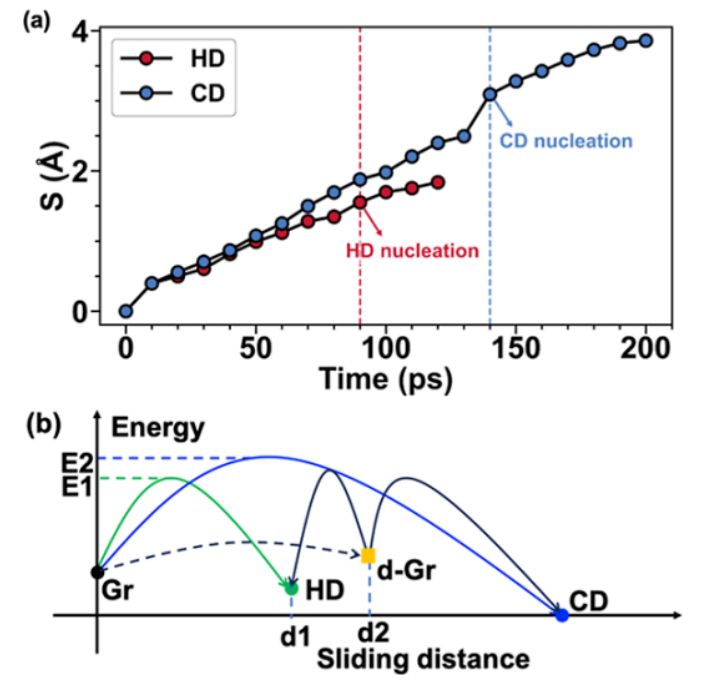
Figure 5. (a) Sliding distance of graphite layers during the nucleation process; (b) Schematic illustration of how the sliding distance influences the formation of HD and CD.
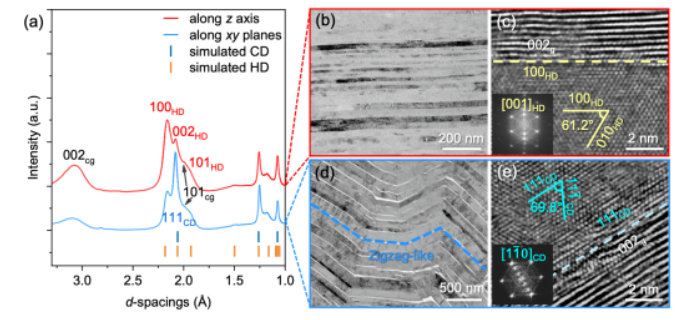
Figure 6. Phase transformation study of thermally compressed graphite along the z-axis and in the xy plane, respectively, under conditions of 20 GPa and 1200°C, leading to the formation of hexagonal diamond (HD) and cubic diamond (CD).
The research titled "Key for Hexagonal Diamond Formation: Theoretical and Experimental Study" was primarily conducted at Sun Yat-sen University. Associate Professor Shengcai Zhu and PhD student Guwen Chen from the School of Materials Science at Sun Yat-sen University, along with Dr. Xiaohong Yuan from the School of Physics, National Key Laboratory of High Pressure and Ultra-Hard Materials, and the Center for Extreme Conditions in High-Pressure Science at Jilin University, served as the first authors. Associate Professor Shengcai Zhu, Professor Yanglong Hou from Sun Yat-sen University, and Professor Hu Tang from Jilin University were the co-corresponding authors. Other contributors include Minghao Wan, a master’s student at Sun Yat-sen University; Assistant Professor Yong Cheng and Professor Mingsheng Wang from Xiamen University; and Dr. Baoyin Xu, a PhD candidate at Jilin University.
High-quality, transparent submicron-diamond synthesis under "low-pressure" conditions
Carbon materials have consistently attracted significant attention in the field of materials science due to their unique structural diversity and outstanding physicochemical properties. In recent years, both domestically and internationally, remarkable progress has been made in the synthesis and performance development of disordered carbon materials. Among these, subcrystalline diamond has garnered considerable interest as a special class of disordered sp3-bonded carbon, thanks to its distinctive near- and medium-range ordered structure. In 2021, a research team led by Dr. Huiyang Gou at the Beijing Center for High Pressure Science first successfully synthesized subcrystalline diamond (Nature 599, 605–610, 2021; Professor Hu Tang served as the first author of the paper).
However, the research team believes that the 30 GPa synthesis pressure is still too high, posing challenges for its future industrial-scale preparation and practical applications. To address this issue, the team introduced uniaxial stress into the high-temperature, high-pressure environment, successfully synthesizing subcrystalline diamond under conditions of 16 GPa and 1600 K—reducing the required pressure by 50% (Figure 7). Notably, this reduced pressure level already aligns with the pressures achievable in industrial settings, paving the way for the potential large-scale production of subcrystalline diamond.

Figure 7. Breaking the traditional experimental phase diagram of C60 under high temperature and high pressure, we obtained transparent subcrystalline diamond at 16 GPa and 1600 K.
To delve deeper into how uniaxial stress influences the synthesis of subcrystalline diamond, the research team employed large-scale molecular dynamics simulations to compare the structural transformations of C60 molecules under uniaxial pressure (NIP) versus hydrostatic pressure (IP). Their findings demonstrated that introducing uniaxial stress significantly disrupts the spherical symmetry of C60 molecules, causing them to collapse at much lower pressures. This process accelerates the amorphization of C60 under high pressure (as shown in Figure 8), facilitating its transition into subcrystalline diamond even at relatively low pressure conditions. The study highlights the critical role of uniaxial stress in the low-pressure formation of subcrystalline diamond, offering a promising and cost-effective strategy for developing new, low-cost high-pressure materials.

Figure 8. Molecular dynamics simulation of the structural evolution of C60 under non-equilibrium pressure conditions.
The research achievement, titled "Uniaxiality-Induced Reduced-Pressure Synthesis of Ultrahard Paracrystalline Diamond," was led by the School of Physics at Jilin University, the National Key Laboratory of High Pressure and Ultra-Hard Materials, and the Center for Extreme Conditions in High-Pressure Science. The first author of the paper is Dr. Yue Pan, a doctoral candidate, with Dr. Xiaohong Yuan serving as the co-first author. Professor Bingbing Liu, Professor Hu Tang, Professor Shengcai Zhu from Sun Yat-sen University, and Assistant Researcher Kuo Hu are the co-corresponding authors. Additional collaborators include Professor Mingsheng Wang and Assistant Professor Yong Cheng from Xiamen University, as well as Professors Zhaodong Liu and QuanJun Li from Jilin University, along with doctoral candidates Quanyin Xu and Shucheng Liu, and master’s students Zhitong Wang and Shida Wang.
The above research was jointly supported by the National Key Research and Development Program (No. 2018YFA0305900), the National Natural Science Foundation of China (U23A20561, 12274383, 21703004, 52172240), the Open Research Project of the State Key Laboratory of High-Pressure Physics and Ultra-Hard Materials (No. 202403), and the Guangdong Provincial Natural Science Foundation (No. 2025A1515012119). It also received strong support from the B1 and B3 beamlines of the National Major Scientific Infrastructure—Comprehensive Extreme Conditions Experimental Facility.
Latest News
Latest News

 2026-01-09


Get a Free Consultation
If you're interested in our products, please contact us today for more detailed information.

Liaocheng Xinko Pyrophyllite Co., Ltd. is a company specializing in the professional manufacturing and processing of products such as automatic four-column hydraulic presses, diamond synthesis components, pyrophyllite stones, magnesia rings/cups, and graphite tubes.
Liaocheng High-Tech Industrial Development Zone, Bayiliang Village, North End, Jiuzhou Subdistrict Office