


Over 10,000 times stronger! Diamonds push the limits once again.
Release date:
2025-07-24
Narrow-linewidth lasers are crucial in a wide range of applications, including precision sensing, spectroscopy, and quantum science. Beyond spectral width, the shape of the spectrum also plays a critical role—particularly depending on the specific application scenario. For instance, the power levels on either side of the laser line can introduce errors during optical manipulation of qubits, potentially compromising the accuracy of atomic clocks. In terms of laser frequency noise, Fourier components generated by spontaneous emission entering the laser mode typically exceed 105 Hz, directly influencing the amplitude characteristics on both sides of the line. Together with the Henry enhancement factor, these elements collectively define the quantum limit—the famous Schawlow-Townes (ST) limit—which sets the fundamental lower bound for the achievable effective linewidth after mitigating technical noise sources such as cavity vibrations and length drifts.
Therefore, minimizing quantum noise is a critical step in the design of narrow-linewidth lasers. In practice, the desired linewidth is achieved by fine-tuning key factors that govern the ST limit—such as laser power, employing high-Q-factor cavities, and selecting gain media with low field-amplitude-to-refractive-index coupling (i.e., a low Henry factor). Titanium-sapphire lasers, fiber lasers, and external-cavity semiconductor lasers are prime examples of devices capable of delivering the hertz-level linewidths required for many of the most demanding coherent laser applications. Nevertheless, designing a laser that simultaneously meets the stringent requirements for linewidth, power, and wavelength in a given application remains a significant challenge.
Researchers at Macquarie University have developed a new technology that reduces the linewidth of laser beams by more than 10,000 times, a breakthrough that could revolutionize fields such as quantum computing, atomic clocks, and gravitational wave detection. The findings were published in APL Photonics under the title "Linewidth Narrowing in Raman Lasers."
Researchers are using materials with exceptional thermal performance that can provide a stable testing environment. Diamond The crystals were used to test the technology. Inside a cavity, they employed diamond crystals just a few millimeters in diameter to examine an intentionally introduced "noisy" input beam with a linewidth exceeding 10 MHz. Their Raman scattering technique successfully compressed the linewidth of the output laser beam down to 1 kHz—reaching the sensitivity limit of their detection system—and achieved a compression factor greater than 10,000 times.
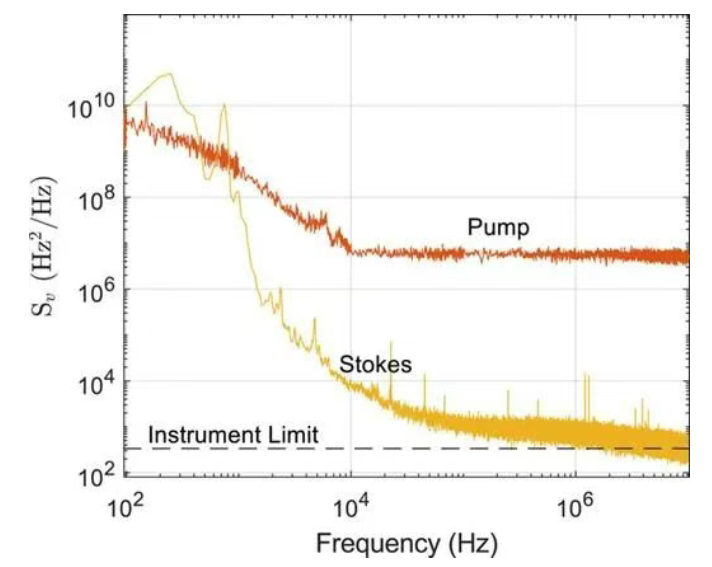
Figure 1 shows that, according to the single-sided PSD measurement results, significant noise narrowing is observed for both the pump seed and Stokes components at high frequencies.
The research team leveraged the principle of stimulated Raman scattering to use lasers in exciting higher-frequency vibrations within materials, achieving a linewidth narrowing effect thousands of times more effective than conventional methods. At its core, this approach introduces a novel laser spectral purification technique that can be applied to a wide range of input laser types. This represents a groundbreaking advancement in the field of laser technology.
This new technology addresses the issue of tiny, random timing variations in light waves that cause laser beam purity to degrade and reduce precision. In an ideal laser, all light waves should be perfectly synchronized—but in reality, some waves end up slightly ahead or behind others, leading to fluctuations in the light’s phase. These phase fluctuations introduce “noise” into the laser spectrum, blurring its frequency and diminishing its color purity.
The principle behind Raman technology lies in converting these temporal irregularities into vibrations within the diamond crystal, where they are swiftly absorbed and dissipated—occurring within just a few trillionths of a second. This process leaves the remaining light waves with smoother oscillations, resulting in higher spectral purity and producing a remarkable narrowing effect on the laser spectrum.
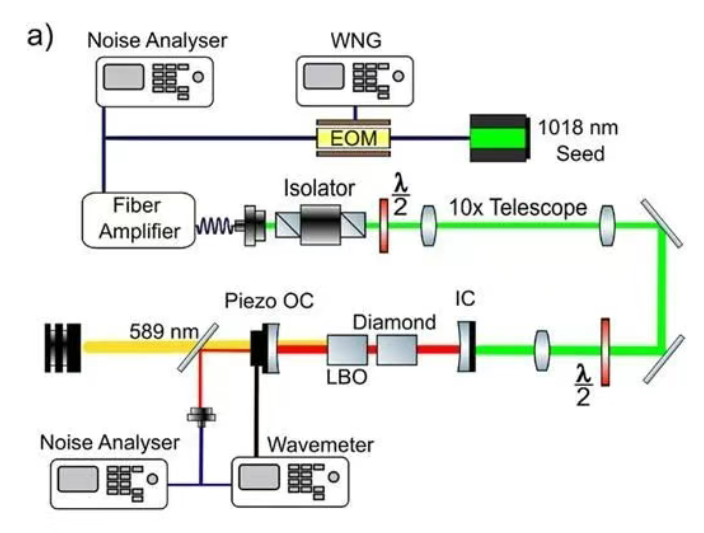

Figure 2. (a) Schematic diagram of the laser system, showing the key components. WNG: White Noise Generator, OC: Output Coupler, IC: Input Coupler, EOM: Electro-optic Modulator, LBO: Lithium Triborate, λ/2: Half-wave Plate. (b) Stokes frequency drift with feedback (orange) and without feedback (blue). For the case with feedback, the piezo voltage is included to indicate drift compensation.
In addition to their exceptional linewidth narrowing effect, researchers have found that the Raman technology offers multiple advantages over the traditional Brillouin method, including the ability to achieve even narrower minimum linewidths. These ultra-narrow-linewidth lasers hold several cutting-edge application areas:
Quantum computers rely on the precise control of lasers to manipulate qubits—quantum bits that serve as the fundamental units of quantum information. Currently, existing lasers introduce phase noise, which can lead to errors in quantum computations. Achieving higher spectral purity, however, would significantly enhance the reliability of quantum computers.
Atomic clocks are the foundation of GPS navigation—higher spectral purity will enhance their performance and could potentially pave the way for new discoveries in fundamental physics down the road.
Gravitational Wave Detection: Gravitational wave detectors, which measure the minuscule distortions of spacetime, can become even more sensitive by employing laser beams with narrower linewidths—potentially enabling the detection of fainter signals originating from distant cosmic events.
Latest News
Latest News

 2026-01-09


Get a Free Consultation
If you're interested in our products, please contact us today for more detailed information.

Liaocheng Xinko Pyrophyllite Co., Ltd. is a company specializing in the professional manufacturing and processing of products such as automatic four-column hydraulic presses, diamond synthesis components, pyrophyllite stones, magnesia rings/cups, and graphite tubes.
Liaocheng High-Tech Industrial Development Zone, Bayiliang Village, North End, Jiuzhou Subdistrict Office